


Why the '53 Corvette Could've Been Better, Yet the Same
- Justin Sifford

- Oct 21, 2021
- 5 min read
Updated: Nov 3, 2021
Analyzing what could have been the best iteration of America's first Sportscar.
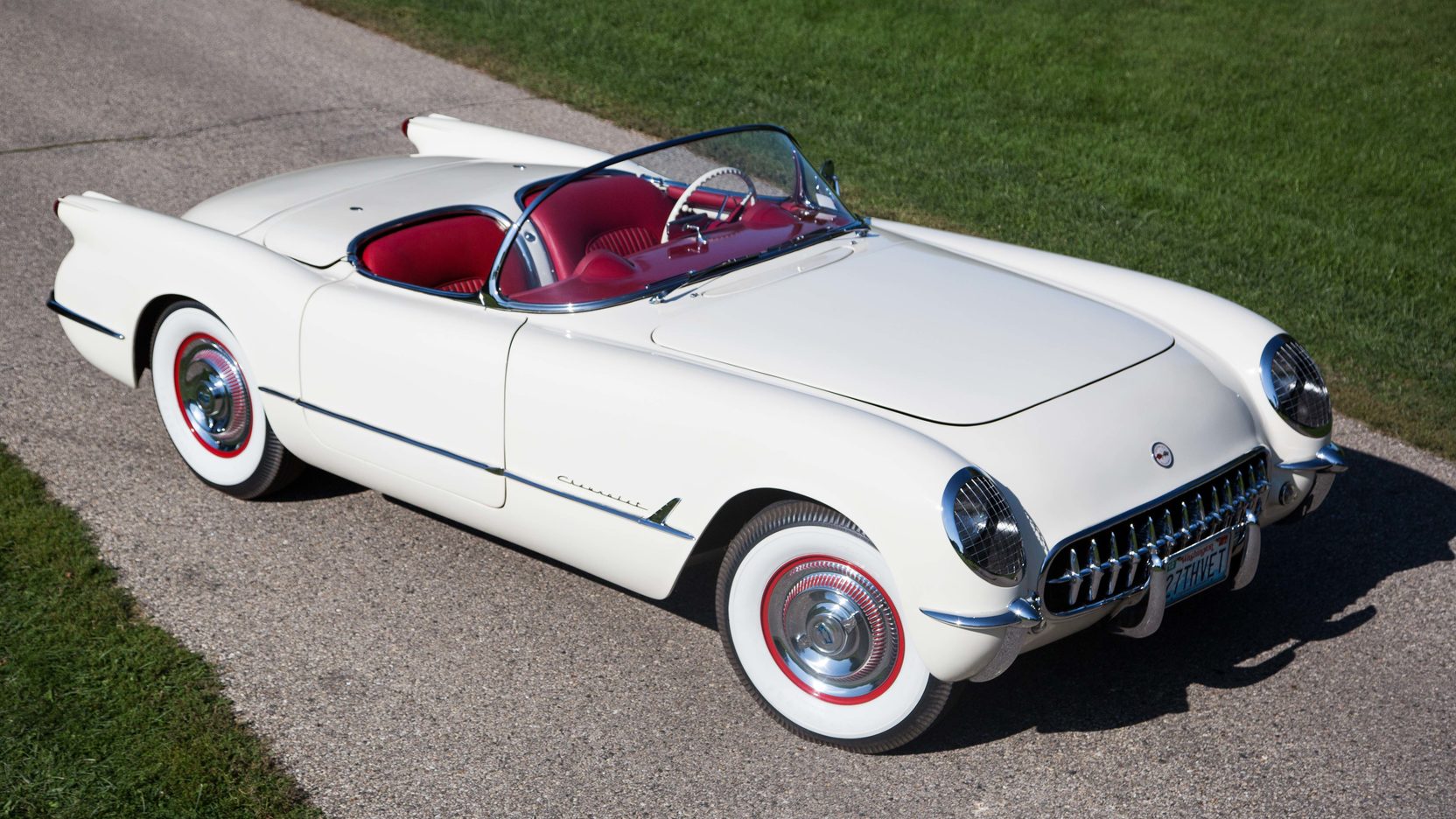
For years, I have always loved the 1953 and '54 Corvettes, they hold a very special place in my heart. It was one of the first cars I could recognize by sight, and one I aspire dearly to own. However, there are problems with this car that would be a big disappointment to me, and many others who expect greatness. Like all cars, there must be an area where the grass isn't so green, and I have a few reasons why that could be the case, despite how much presence the O.G. 'Vette has.
So, what all was wrong with the beautiful C1 Corvette? Well, let's break down why shall we:
The Engine Was Good, But Not Great.
Okay, the early 1950's wasn't a great time for General Motors when it came to being on the cutting edge of technology (until they introduced the Small Block of course) but, the selection of the 235 cubic inch displacement "Blue Flame" six was a formidable powerplant choice. Considering the car's main competitors at the time all had inline six cylinders as well, such as the Jaguar XK120, the Triumph TR2, and others did suffice with similar drivetrain layouts, just at a smaller engine size. The real caveat to sportiness with the Blue Flame Six was a low redline, and being slightly down on power, although most engines of the period were not very kind to high RPM, and not 500 horsepower units either. It did receive a higher lift camshaft than the standard 235, pulled from it's 261 c.i.d. truck variant, a fully pressurized oiling system, split exhaust manifolds, and triple Carter YF single barrel side-draft carburetors. It made an impressive 150HP, and was stout enough to propel the fiberglass 'Vette down the road well, but still lackluster compared to the Jaguars and MGs it fought against. Chevrolet just didn't have the technology yet to throw at the 235 to make it powerful as the Europeans, or as well balanced.
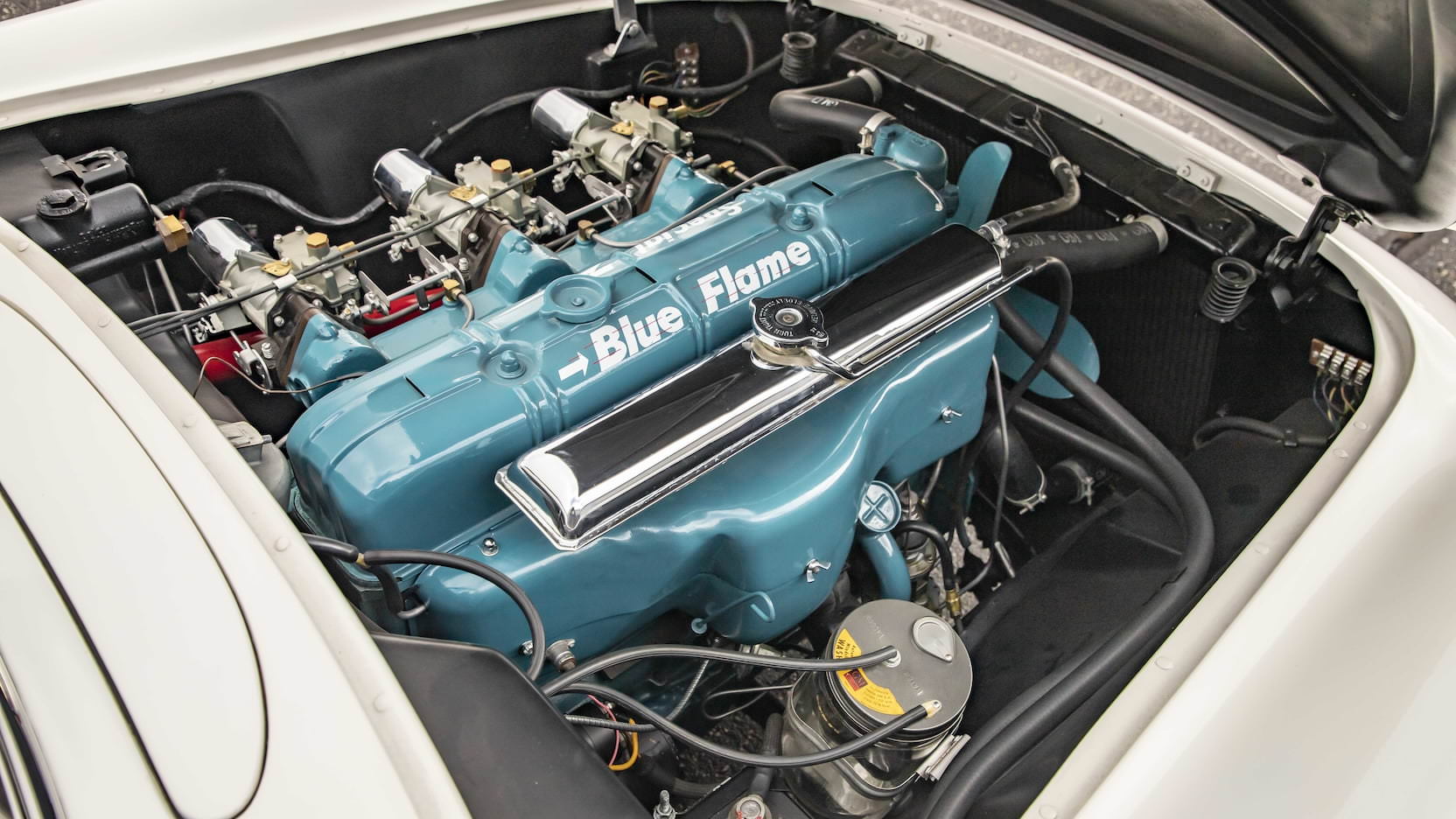
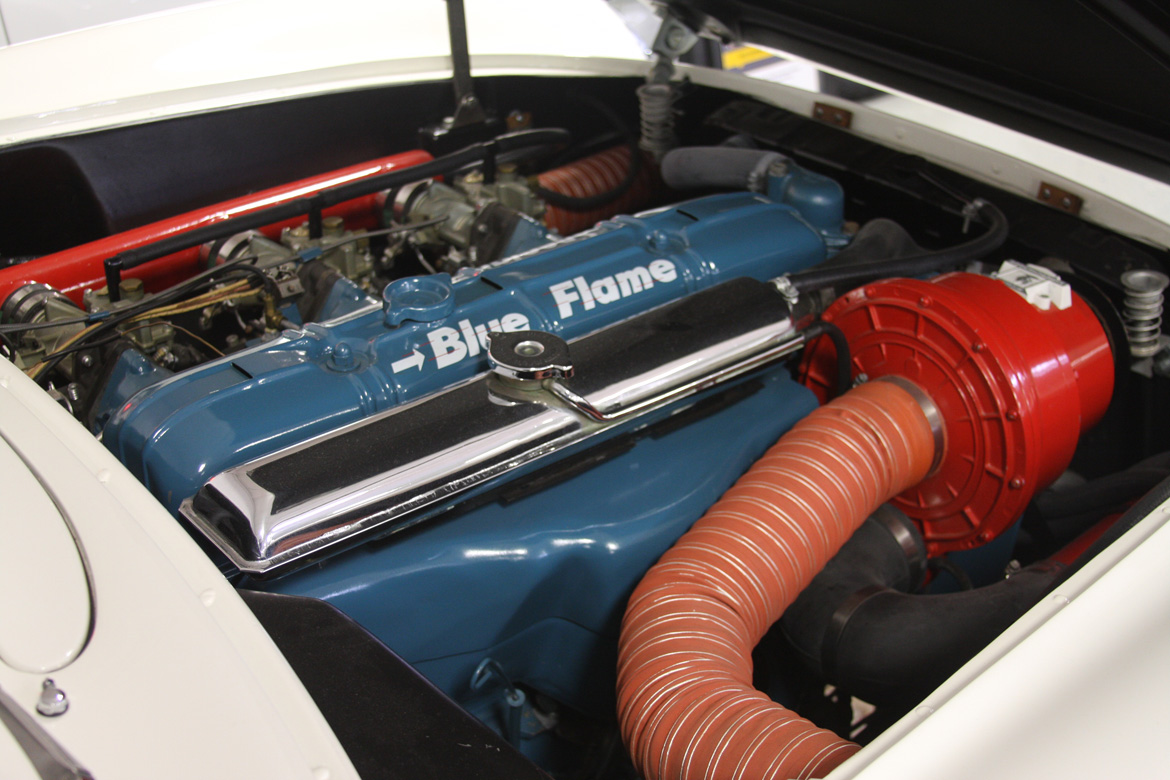
I feel that the six cylinder platform could've been one to build on in the latter years, especially to market to the more "budget" sportscar options, even with a competing V-8 option existing in the Corvette itself. I would have personally opted for an optional inline six variant of the Corvette, even if it wasn't marketed as a Corvette per say. There was an extremely rare option to fit a Paxton Supercharger to the 235 to help with acceleration where a longer powerband would've taken over, but it was noticeable, but not revolutionary. McCollough actually bought Corvette number 24 an affixed a centrifugal supercharger making a whopping 6psi of boost, but it was one-off, and very rare, and didn't secure the fate of the 235 as a powerful engine for the 'Vette by far.
The Transmission Was Not Sporty, At All.
The main transgressor of the drivetrain, the greatest offender, and the main perpetrator is the sluggish, binary, unapologetic, asthmatic, and indecisive Powerglide automatic transmission. Although seriously advanced and capable for the time, and truly revolutionary to the car industry that we know today, it was a serious fumble for the Corvette. Yes, modern Corvettes come with automatics, and it has always been an option since 1956, it is different than having only two gear ratios to choose from.

A very energetic, exponential buildup to about 4,000 RPM, and a dead fall back down to about 1,800 RPM, like being hit with a wood-splitting maul is not sporty, not even remotely. There's a certain NSFW action you can attribute driving a two speed Powerglide to, and that's not an experience fit for a two seat sportscar. It's ease of driving isn't an attribute it's competitors possessed, to be fair, but in all actuality, the target demographic for this sportscar didn't really care about ease-of-use. GIs returning from overseas, bringing MG MGAs, Jaguar XK120s, and Morgan PlusSixes didn't care about automatics, judging by their cars of choice.

So, What Did Chevrolet Do?
With the right foundation for the car laid forth, the biggest flaw being the transmission was not a choice, rather forced by the output of Chevrolet's well-built 235 backed them into the corner of the "shlautomatic." The engineers simply did not have a manual transmission that could handle the power of the Blue Flame Six. Independent front double-wishbone (short-long-arm or SLA to those technical folks) suspension meant great performance of the time, and Delco twin-tube dampers within the front coil springs also attributed to the Corvette's reputation for being well handling, until the introduction of independent rear suspension in 1963. Corvettes sadly didn't get the V-8 option until a short run into the 1955 model year, where a few 155 HP 235s still found their way into some cars, and the V-8 wasn't offered with a manual transmission until late in the '55's production run, a three speed unit made to handle the power of the 265 cubic inch Small Block. And the rest, is history.
Well, What Could It Have Been?
This isn't just a history article on the Corvette, I am here to explain how it could've been better with the same elements it was conceptualized with. The inline six could have remained with a few performance fixes. It would have been competitive enough if the transmission allowed it to feel more sporty. The transmission was the main issue, even with the '55 receiving a new V-8, it still had a Powerglide automatic until late in the model year, thus it fell short of the moniker of "sportscar" yet again. So, with a proper three or four speed manual, it would have been free to express it's six cylinder powerplant, and it could've set itself ahead of the Nash-Healey roadster it competed with in 1953 and '54 as an American bred sportscar. The game changed for Chevrolet in 1955, when Ford's Thunderbird was seen as competition, even though it was marketed as a "personal luxury vehicle," rather than a sportscar. It still had the correct formula, minus having a big thumping V-8, (and also available with a two speed automatic, which for this is more fitting).

Chevrolet had a target-lock on making a competitor for Ford's luxury barge, but they lost sight of one factor. The Thunderbird was not a sportscar, it was a luxury convertible, everything the Corvette wasn't. Ford did not intend for the Thunderbird to compete with Chevrolet's Corvette, but in it's introduction, it slaughtered the poor fiberglass roadster in sales. The purpose of the Corvette's inception onto the scene was to establish an American sportscar to compete with the foreign automakers, and they could have achieved such things with the noble Blue Flame, just with a little investment into six cylinder performance. The Corvette did have some teething issues in the beginning with fit and finish issues stemmed from low quality control, as all 300 examples built in1953 were assembled by hand, with little to no production automation, in a rehashed and recycled Chevrolet truck plant in Flint, Michigan. Water leaks, doors opening while driving, and squeaks and rattles were main concerns of consumers at first, but eventually, problems were corrected.
To me, the most perfect Iteration of the first Corvette would've been a four-speed, six cylinder, independent rear suspension, peppy roadster, that would outshine the Jaguars, MGs, and Triumphs of the day, with greater reliability, good looks, and a fairly low price point, everything that Harley Earl wanted from the initial concept, just plagued by Chevrolet's lack of departure from off-the-shelf parts usage halted the initial vision the engineers desired.
That just about wraps up the deal for now, maybe we'll dive deeper into Corvette history, or what Chevy could've built to continue that minimalistic sportscar formula that drove the Europeans into the hall of fame of sportscar legacy. Or what Ford could have built to compete with the Corvette, rather than depending on it's pony cars.
As always, stay safe, be kind, and never stop learning.
Comments